Slow Mornings in Kyoto
Lanterns, temple bells, and the quiet ritual of the early hours in Japan's old capital.
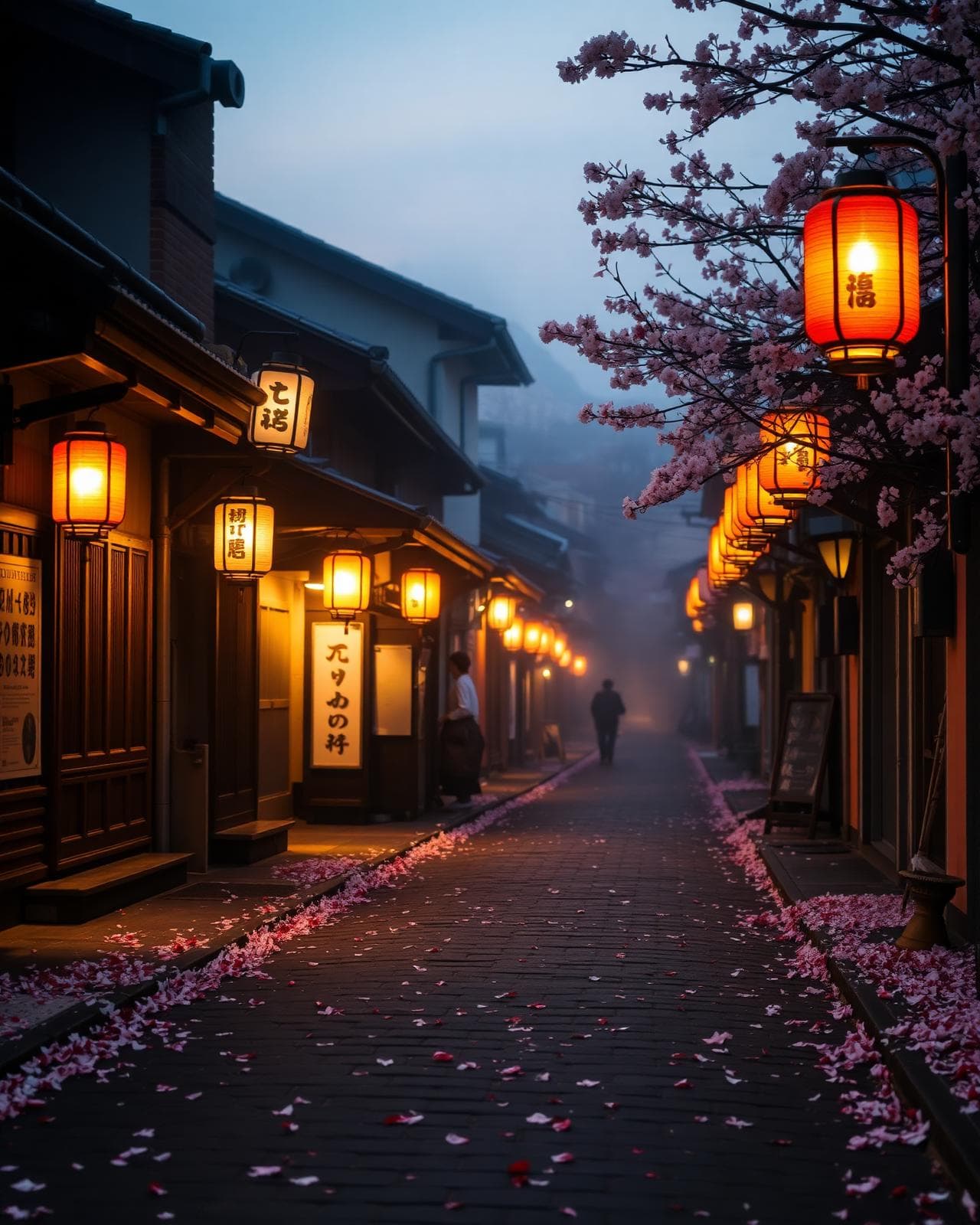
The first time I walked through Gion before sunrise, I understood why people return to Kyoto again and again. The city in those hours belongs to no one — not the tourists with their selfie sticks, not the schoolchildren in navy uniforms, not even the geiko hurrying between teahouses. It belongs to the mist that pools on the cobblestones and the lanterns still burning from the night before. I had been awake since four, betrayed by jet lag, and rather than fight it I pulled on a sweater and walked out into a city that felt like it had been left running for me alone.
Ihad arrived two days earlier, jet-lagged and over-prepared, with a list of temples that ran to three pages. The list was color-coded. The list had walking times between sites. The list assumed I was the kind of person I am not. By the third morning I had folded it into quarters and tucked it into the back of a notebook I would not open again for the rest of the trip. Kyoto is not a city you conquer with an itinerary. It rewards a different kind of traveler: the one willing to sit on a wooden veranda for an hour and watch the rain change the color of moss.
My ryokan was in Higashiyama, on a lane so narrow the taxi driver refused to enter it. He stopped at the corner, pointed vaguely uphill, and apologized in a way that left no room for discussion. I dragged my suitcase the last two hundred meters past shuttered shops and the smell of wet cedar, the wheels catching on every stone. The okami met me at the door with a pair of slippers and the faintest bow, and from that moment everything happened on her timing, not mine. Shoes off here. Tea at four. Bath available from six. The schedule was hers and I was, gratefully, a guest inside it.
—a note from the trip
The one I'd repeat: Private Tea Ceremony in Gion. Two hours with a tea master in a 200-year-old machiya. The one tour I'd actually repeat.
Breakfast was served at seven, in a private room with a view of a garden no larger than a parking space and ten times more considered. Grilled mackerel, pickled radish, a small bowl of rice, miso the color of tobacco, a single square of tamagoyaki still warm from the pan. I ate it cross-legged on a tatami floor while a sparrow watched me from the garden. It is the kind of meal that makes you remember every breakfast you have ever rushed through standing at a kitchen counter, every cereal eaten over a sink, every protein bar consumed on a train.
—a note from the trip
I stayed at Ryokan Yoshida-Sanso. Former imperial villa turned eight-room inn. Book six months out.
The temples I did visit, I visited slowly. Nanzen-ji at opening, before the bus tours arrive — the great wooden sanmon gate emerging from the cedars like the prow of a ship. The moss garden at Saiho-ji, which requires a written request by post and a morning of copying sutras with a brush before they will let you in to walk among the one hundred and twenty shades of green. Hōnen-in, which most visitors miss entirely, where the gate is thatched and the path is swept into perfect parallel lines each morning by a monk who does not look up as you pass. I learned to set a maximum of three temples a day. More than that and they collapsed into one another, a single blurred memory of incense and wood.
"Kyoto doesn't ask for your attention. It waits, patiently, until you slow down enough to notice." There is a particular kind of silence in Kyoto that I have not found anywhere else. It is not the silence of emptiness. It is the silence of arrangement — of a place where someone, generations ago, decided that this rock should sit precisely here, and someone else has been raking the gravel around it in the same pattern every morning since. You feel it most strongly at Ryoan-ji, of course, but also in lesser places: the courtyard of a tiny neighborhood shrine, the entrance to a soba shop, the alley behind a tofu maker where steam rises from a vent at exactly the same hour each day.
Imade one friend that week — a bookseller in a basement shop near Sanjō who spoke careful, beautiful English and recommended a slim volume of Bashō translations that I have since given as a gift four times. We talked for almost an hour, standing among his shelves, about how foreign visitors mistake Kyoto's politeness for distance. 'It is not distance,' he said. 'It is a kind of room we make for you. So you can be here without being watched.' I have thought about that sentence often.
—a note from the trip
What I packed: Muji Soft-Shell Suitcase, 36L. What I packed for two weeks. Fits the overhead on every Japanese carrier.
On my last evening I walked the Philosopher's Path alone in the rain. The cherry trees were past their bloom, their petals plastered to the wet stones in pale constellations. A woman was selling warabi-mochi from a wooden cart, dusting each piece with kinako under a clear plastic sheet. I bought one and ate it standing up, the soft jelly cool against my tongue, the soybean flour catching in my throat. She asked, in a few words of English, where I was going next. Tokyo, I said. She nodded, and then, with great seriousness: 'Kyoto is better.' We both laughed.
—a note from the trip
I read this on the plane: The Roads to Sata, Alan Booth. Read this on the plane. It changes how you see rural Japan.
What stays with me, months later, is not the famous things. It is the smell of binchō-tan charcoal drifting from a yakitori counter at dusk, the cook's tongs clicking like a metronome. It is the way the cypress bath at the ryokan, taken in silence at ten at night, undid the entire day from the shoulders down. It is the sound of a single bell at Chion-in, struck once, the kind of sound you feel in your sternum a full second before you hear it. It is a city that gives you back to yourself in pieces you didn't know you'd lost.
—a note from the trip
Worth booking ahead: JR Pass — 7 day. Worth it if you're doing Tokyo–Kyoto–Hiroshima. Otherwise skip.
Kyoto teaches you, if you let it, that the point of going somewhere is not to see it. The point is to be slowed down by it. To be made to wait for the tea to cool. To learn the bus stop is a five-minute walk and the walk is the better part. To understand that the temple you almost skipped, the one in the rain, is the one you will remember in fifteen years when the famous one has faded. I left with half a list undone and a quiet I have been trying, ever since, to bring home.
Ready to explore Kyoto?
Get immediate access to curated hotel recommendations, offline neighborhood maps, walking route itineraries, and booking advice.
OPEN THE GUIDE →